With the development of the packaging industry, traditional vibrating tray product alignment systems are increasingly unable to meet enterprise needs. At this point, disordered product aligning machines have emerged and are gradually gaining attention from an increasing number of businesses. So, what are the advantages of disordered product aligning machines? And what scenarios are they suitable for? Today, let's talk about this.
First, let's discuss the advantages of disordered product aligning machines. Compared with traditional vibrating trays, the advantages of disordered product aligning machines are quite obvious.
The biggest advantage is strong adaptability—it can handle products of various shapes. Traditional vibrating trays have relatively high requirements for product shape, generally only capable of handling products with regular shapes such as round or square. If a product has an irregular or complex shape, a vibrating tray struggles to handle it, or may even be completely unusable. Disordered product aligning machines, on the other hand, use visual recognition technology—no matter what shape the product is, as long as the camera can recognize it, the machine can align it. Irregular, non-standard, and complex-shaped products can all be handled with ease. This is something a vibrating tray cannot match.
First, it is suitable for scenarios with irregular or complex product shapes. If your products have special shapes that a vibrating tray cannot handle, a disordered product aligning machine is an excellent choice. Examples include shaped candy, shaped hardware parts, specially shaped plastic parts, and toy accessories.
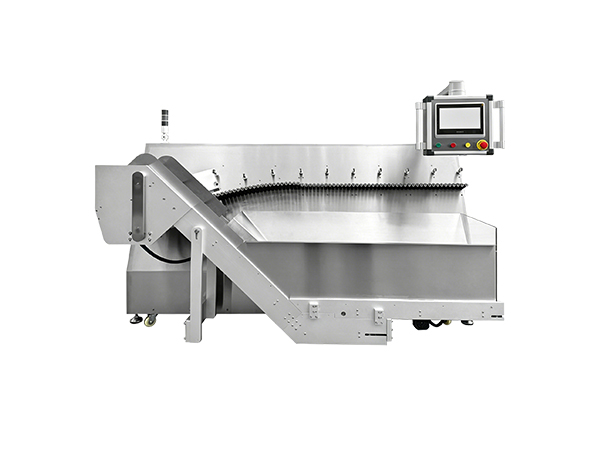
Second, it is suitable for scenarios with high product appearance requirements or products that are easily damaged. If your product has a plated surface, is printed, is easily scratched, or is fragile and prone to breaking and cannot withstand collision or friction, a disordered product aligning machine is suitable. Examples include electronic products, hardware stamped parts, crafts, and fragile items.
Third, it is suitable for scenarios with many product varieties, small batches, and frequent product changeovers. If you have many product types with relatively low volumes for each type and need to change products frequently, the product changeover advantage of disordered product aligning machines can be fully leveraged, greatly improving production efficiency.
Fourth, it is suitable for scenarios with high precision requirements for product orientation and placement. If your product packaging or assembly has strict orientation and placement requirements that a vibrating tray cannot meet, a disordered product aligning machine is worth considering.
Fifth, it is suitable for scenarios that require simultaneous quality inspection. If your products need appearance or dimensional inspection at the same time as alignment, a disordered product aligning machine can serve multiple purposes, saving equipment investment.
Of course, disordered product aligning machines are not perfect—they also have some limitations. For example, the price is relatively higher than that of vibrating trays. For very simple products with very large volumes, a vibrating tray may offer better cost-effectiveness. In terms of speed, although disordered product aligning machines are already quite fast today, for ultra-high-speed requirements, a high-speed vibrating tray may still have the edge.
In summary, with their advantages of strong adaptability, non-damaging product handling, fast product changeover, high precision, and versatile functionality, disordered product aligning machines are being accepted and used by an increasing number of businesses.

Room 305, Building 1, Jieshang Mansion, No. 63 Zhongli Road, Nancheng Subdistrict, Dongguan City


 CH
CH