With the development of the packaging industry, disordered product aligning machines are receiving increasing attention from businesses. This equipment uses visual recognition and robotics technology to automatically align scattered products neatly, solving many problems that traditional vibrating trays cannot address. However, facing the many manufacturers of disordered product aligning machines on the market, how should one make a purchase? Today, let's share a purchasing guide for disordered product aligning machines.
First, look at the machine's alignment precision and speed. These are the most core indicators. Alignment precision refers to whether the machine can accurately place products at the designated position with the correct orientation and precise placement. Speed refers to how many products can be aligned per minute. Different manufacturers have different technical capabilities, and the precision and speed of their equipment can vary greatly. When purchasing, it is best to bring your own products and have the manufacturer run a live test—see the results with your own eyes and whether it meets your requirements. Do not rely solely on the manufacturer's verbal claims; always conduct actual testing.
Second, look at the machine's adaptability. In other words, whether the equipment can handle multiple products and specifications. Many enterprises today have a wide variety of products and frequently change production runs. If the equipment has poor adaptability and requires major adjustments or is even unusable when switching to a different product, that is very troublesome. A good disordered product aligning machine only needs a product parameter switch in the software during product changeover, which can be completed in just a few minutes and is very convenient. It can also handle products with significant differences in shape and size. When purchasing, you can bring several different products for the manufacturer to test and see how well the adaptability performs.
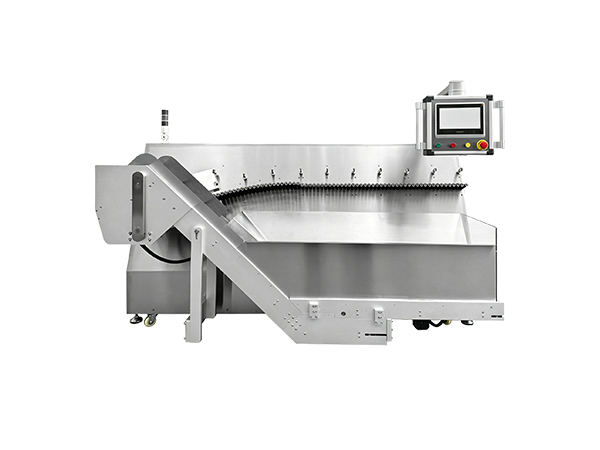
Third, look at the machine's stability and reliability. Equipment is purchased for production—if it breaks down frequently, it not only delays production but also causes frustration. Therefore, stability is very important. How can you judge whether the equipment is stable? You can look at the manufacturer's technical capability and past case studies. Manufacturers with strong technical capability and rich experience typically produce more stable equipment. Additionally, you can ask the manufacturer what the machine's mean time between failures (MTBF) is, what the consumable parts are, and what the service life is. If possible, it is best to visit a customer site to see how the equipment actually performs in use.
Fourth, look at whether operation and maintenance are convenient. The equipment is for workers to use. If operation is too complicated and workers cannot learn it, or if it is very troublesome to use, it will affect usage efficiency. A good disordered product aligning machine should have a user-friendly operating interface that is simple and easy to understand, so that ordinary workers can get started after brief training. Maintenance should also be convenient—daily cleaning, part replacement, and other tasks should all be easy to perform. Do not purchase equipment with overly complex structures that are particularly troublesome to maintain; it will be a headache later on.
Fifth, look at the manufacturer's after-sales service. Disordered product aligning machines are high-tech equipment involving visual recognition, robotics, software, and other fields—when problems occur, most people cannot fix them on their own. Therefore, the manufacturer's after-sales service is very important. Check whether the manufacturer has a professional after-sales service team, whether they can respond promptly, and whether they can provide on-site service. Also check how long the warranty period is and what it covers. It is best to choose a manufacturer that is relatively close to you or has a service presence locally, so that any issues can be resolved promptly and production will not be delayed for long.
Finally, also consider the price and cost-effectiveness, as well as factors such as the equipment's footprint, power consumption, and safety. Overall, when purchasing a disordered product aligning machine, you cannot focus only on the surface—you need to deeply understand all aspects and compare several options before selecting the equipment that is truly right for you.

Room 305, Building 1, Jieshang Mansion, No. 63 Zhongli Road, Nancheng Subdistrict, Dongguan City



 CH
CH