In the food, hardware, pharmaceutical, and other industries, we often see multi-head weigher packaging machines. They can quickly and accurately weigh and package granular and chunky products, offering high precision and speed, and are deeply favored by many businesses. However, many people are not very familiar with their working principle. Today, let's briefly introduce the working principle of multi-head weigher packaging machines.
As the name suggests, a multi-head weigher is a scale with multiple weighing heads. Common configurations include 8-head, 10-head, 12-head, 14-head, and 16-head models—the more heads, the more combination possibilities, and therefore the higher the precision and speed. Its core working principle is to use combinatorial weighing, selecting from multiple weighing hoppers the combination that is closest to the target weight.
Specifically, the working process is as follows:
First is the feeding stage. Material is conveyed by a hoister or other feeding equipment to the main hopper at the top of the multi-head weigher. The material in the main hopper is evenly distributed to the surrounding linear vibrating trays. Each linear vibrating tray is a small vibrating disc that uses vibration to feed material bit by bit into the individual weighing hoppers below.
Each linear vibrating tray corresponds to one weighing unit. Each weighing unit is divided into two layers: the upper layer is a storage hopper, and the lower layer is a weighing hopper. Material first enters the storage hopper from the linear vibrating tray, where it is temporarily held. When the weighing hopper is empty, the storage hopper opens and releases the material into the weighing hopper for weighing.
Each weighing hopper is equipped with a high-precision weighing sensor underneath, which can accurately measure the weight of the material in that hopper. The weight data from all hoppers is transmitted to the control system in real time.
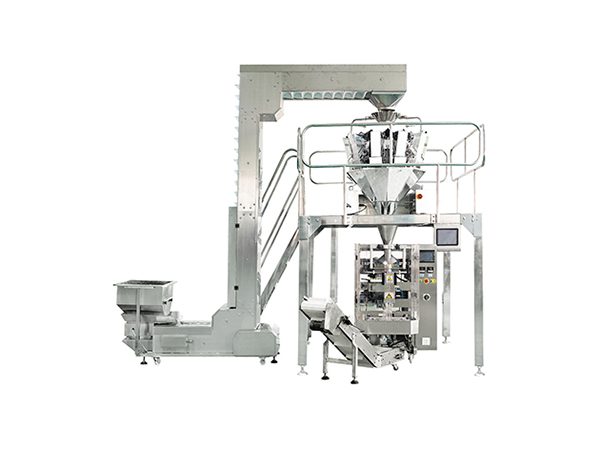
Next comes the most critical stage: combinatorial calculation. Based on the weight data from each weighing hopper, the control system quickly performs combinatorial calculations. For example, if the target weight is 100 grams, the system will find, from among more than a dozen hoppers, the combination of a few hoppers whose total weight is closest to 100 grams. This calculation process is extremely fast—thousands or even tens of thousands of calculations can be performed per second, instantly selecting the optimal combination.
Once the combination is selected, the corresponding weighing hoppers open simultaneously, releasing the material into the packaging machine below for packaging. After the weighed material has been released and the weighing hoppers are empty, the storage hoppers above open to reload them with material for weighing, ready for the next combination cycle.
This cycle repeats continuously—feeding, weighing, combining, and discharging—achieving high-speed, high-precision weighing and packaging.
Why use multi-head combinatorial weighing? Because a single weighing hopper can hardly weigh exactly the target weight—it is always slightly over or slightly under. By combining multiple hoppers, the most close-to-target combination can be selected from many possibilities, naturally resulting in higher accuracy. Moreover, because multiple hoppers operate simultaneously, the speed is also much faster than single-head weighers.
In addition to the weighing section, another important component of a multi-head weigher is the control system. Modern multi-head weighers mostly use PLC or industrial computer control with a touchscreen interface, allowing parameters such as target weight and packaging speed to be set. They can also display various operating data, making operation very convenient.
The precision and speed of a multi-head weigher depend not only on the number of heads but also on the sensor accuracy, the quality of the algorithm, and the mechanical structure design. A high-quality multi-head weigher uses high-precision digital sensors, optimized combinatorial algorithms, and rational mechanical design, achieving accuracy of ±0.1 gram or even better and speeds of over a hundred packages per minute.
Of course, multi-head weighers are not a universal solution—they are primarily suitable for free-flowing solid materials in granular, chunky, or short-strip forms, such as candy, nuts, chips, small hardware parts, and tablets. They are not well suited for powders, liquids, or highly viscous materials.

Room 305, Building 1, Jieshang Mansion, No. 63 Zhongli Road, Nancheng Subdistrict, Dongguan City



 CH
CH